

What exactly is 80s apparel?
80s apparel is maximalism made physical: bigger shoulders, bolder colors, louder prints, and silhouettes that refused to apologize for taking up space. The decade operated on a single principle — more is more — and every clothing category reflected it, from the boardroom to the gym floor.
The signature elements you need to know:
- Oversized shoulder pads built into blazers, dresses, and even casual tops
- Power suits with wide lapels, double-breasted fronts, and exaggerated structure
- Acid-washed denim in jeans, jackets, and skirts with that bleached, marbled finish
- Neon leggings and leg warmers driven by the aerobics craze and Jane Fonda’s workout videos
- Graphic T-shirts featuring band logos, pop culture references, and bold screen prints
- Lycra and spandex body-conforming pieces that let fabric follow the body rather than dictate to it
- Polyester blends and jersey knits used for tracksuits, bodysuits, and sportswear crossovers
Fashion historians at the Fashion Institute of Technology note that the decade actually opened with softer “New Romantic” silhouettes before pivoting hard into power dressing by the mid-1980s. Vogue described the era’s fuel as simply “power,” showing up in stock portfolios, physiques, and clothing in equal measure. The result was a decade with at least four distinct substyles running simultaneously: power dressing, athletic wear, preppy collegiate, and punk DIY.
Key clothing items and accessories that defined the decade
The 1980s produced a surprisingly wide catalog of pieces across every demographic. Here is what actually defined the era:
Clothing:
- Acid-wash denim jeans and jackets — the chemical bleaching process gave denim a marbled, faded look that became synonymous with casual 80s cool
- Power suits — sharp, angular blazers with padded shoulders worn by women entering corporate spaces and men on Wall Street alike
- Neon spandex leggings — worn both in aerobics classes and on city streets, often in electric pink, lime green, or cobalt blue
- Oversized graphic tees — screen-printed with band names, cartoon characters, and pop culture logos; worn loose and often tucked asymmetrically
- High-waisted jeans — straight-leg or slightly tapered, sitting well above the hip and often worn with a tucked-in blouse
- Off-the-shoulder sweatshirts — popularized by Flashdance in 1983 and worn with leggings as everyday casual wear
- Parachute pants — MC Hammer made them iconic; lightweight, billowy, and often in bold solid colors
- Body-con dresses in Lycra, pioneered by designers like Azzedine Alaïa and Donna Karan
- Preppy staples including polo shirts with popped collars, cable-knit sweaters, and seersucker suits
Accessories:
- Chunky plastic hoop earrings in neon or primary colors
- Scrunchies in velvet, satin, or cotton print fabrics
- Rubber and plastic bracelets stacked up the arm, popularized by Madonna
- Leg warmers worn scrunched over leggings or jeans
- Neon belts cinched over oversized tops or blazers
- Adidas Superstars and other athletic sneakers elevated to street-wear status by Run-D.M.C.
Children’s fashion mirrored adult trends with brighter colors and bolder patterns, while sportswear brands like Adidas, Fila, and Reebok crossed from the gym into everyday style. The vintage athletic wear influence from this era still shapes how gym-to-street dressing works today.
How to style 80s wear without looking like a costume
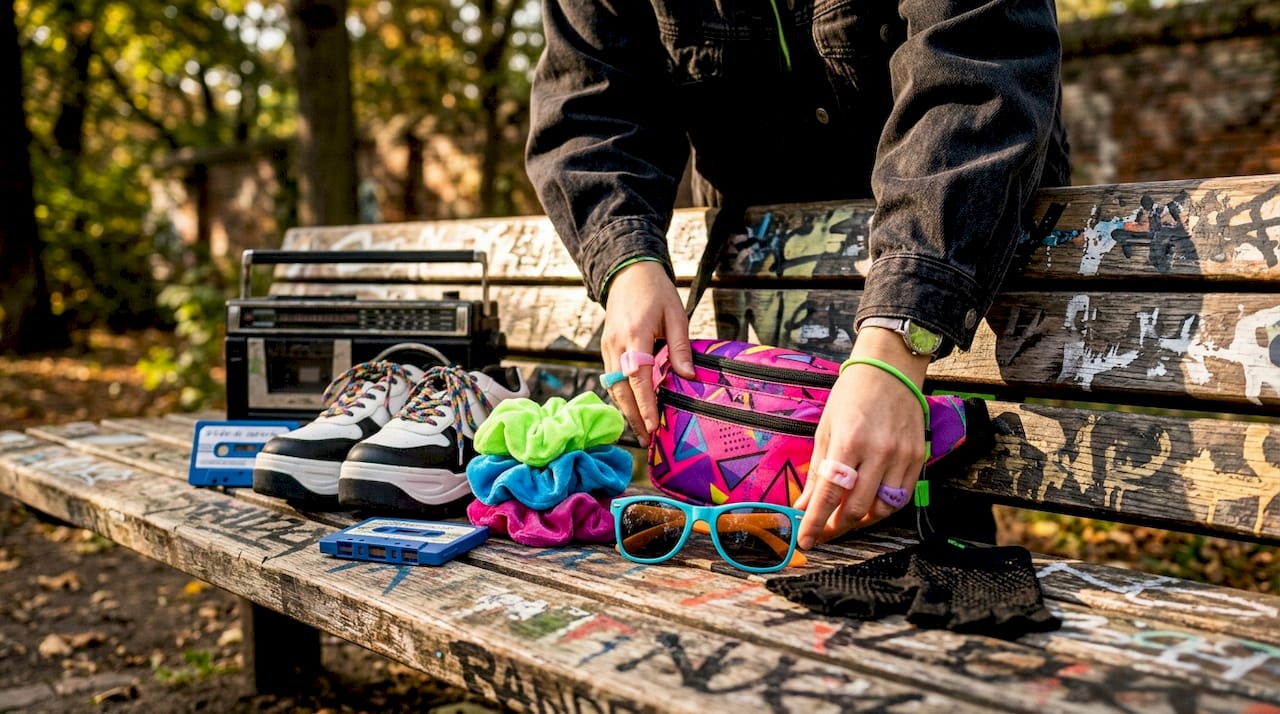
The single most common mistake is wearing too much of the decade at once. Pick one statement piece and build around it with modern basics. An oversized 80s blazer with padded shoulders reads as fashion-forward when paired with straight-leg modern trousers and a plain white tee. The same blazer over a graphic tee, neon leggings, and chunky earrings reads as a Halloween costume.
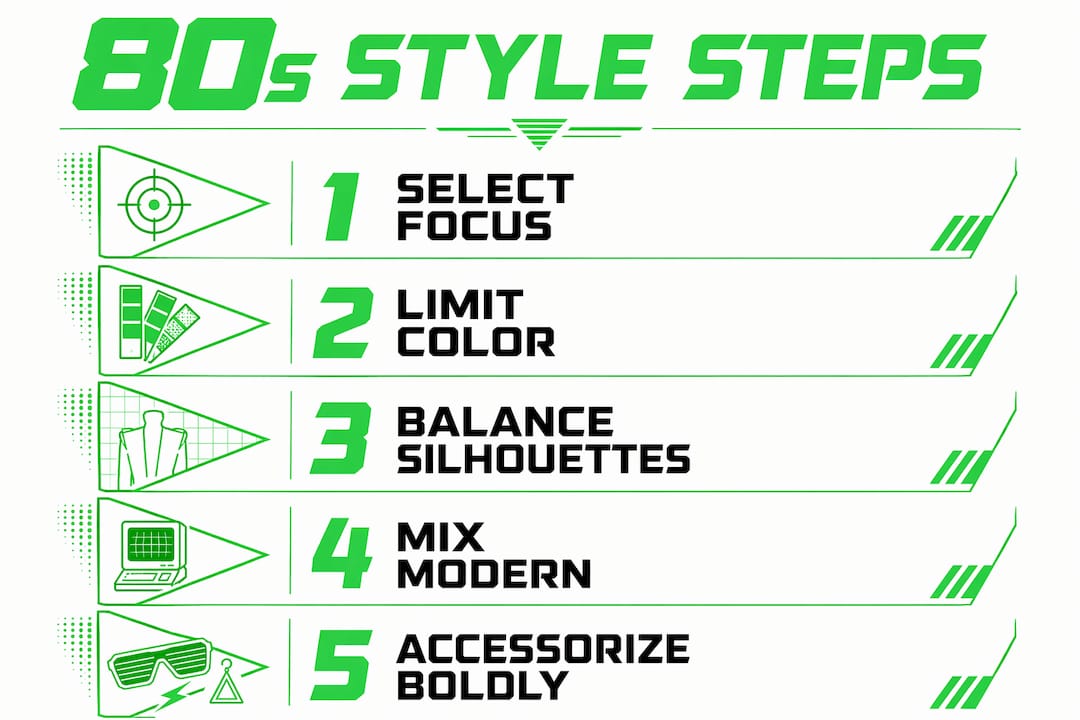
Pro Tip: Fusion styling is the golden rule: one bold vintage or retro piece anchors the look, while everything else stays contemporary. A single acid-wash denim jacket over a neutral outfit lands perfectly; a full acid-wash set does not.
Tailoring is the other piece most shoppers overlook. Vintage 80s garments were often constructed around the undergarments of their era, which means the fit can look boxy or misshapen on a modern body without alterations. A quick trip to a tailor to slim the sleeves on a power blazer or take in the waist of a vintage dress transforms the piece entirely.
Styling do’s and don’ts:
- Do pair a statement shoulder blazer with slim modern pants and minimal accessories
- Do use neon accessories (a belt, earrings, sneakers) to add an 80s nod to an otherwise neutral outfit
- Do choose one cohesive substyle: punk, power dressing, or athletic wear — not all three at once
- Don’t wear head-to-toe matching neon unless the occasion is explicitly themed
- Don’t skip tailoring on vintage pieces; ill-fitting clothes undercut the whole look
- Don’t mix conflicting 80s aesthetics like preppy polo shirts with punk safety-pin details
The oversized silhouette that defined 80s power dressing has returned to 2026 runways, which means the timing for incorporating these pieces has never been better. Marie Claire noted that fall 2026 runways delivered strong shoulders and opulent finishes straight from the 80s playbook.
Vintage vs. retro 80s apparel: how to tell them apart
The distinction matters more than most shoppers realize, both for authenticity and for your wallet.
Vintage 80s apparel refers to original garments actually made during the 1980s. These pieces carry period-correct construction details, fabric compositions, and labels. They are collectors’ items as much as clothing, and their value can appreciate over time. The trade-off is condition: fabric aging, undergarment-dependent construction, and sizing that often runs small by modern standards.
Retro 80s apparel is modern clothing designed to evoke the decade’s aesthetic. These pieces use contemporary fabrics and construction, fit modern bodies without alteration, and cost significantly less than authentic vintage. The trade-off is that they lack the historical authenticity that collectors and purists care about.
Buying considerations:
- Fit and tailoring: Vintage pieces almost always need alterations; retro reproductions typically do not
- Fabric aging: Check vintage items for fabric degradation, fading beyond the intended design, and weakened seams
- Labels and construction: Authentic 80s garments carry period labels from brands like Levi’s, Norma Kamali, or department store house labels; stitching and lining quality reflect the era
- Resale value: True vintage holds and sometimes gains value; retro reproductions do not
- Price point: Authentic vintage commands premium pricing, especially for designer pieces; retro options are accessible at most price points
- Sourcing: Thrift stores, estate sales, flea markets, and curated online vintage shops carry authentic pieces; modern retailers and e-commerce platforms stock retro reproductions
Pro Tip: When shopping vintage in person, check the care label. Garments from the early 1980s often list care instructions without barcodes or modern regulatory symbols, which is a reliable authenticity signal.
Simpletee’s graphic tees bring 80s fandom culture into 2026
The graphic T-shirt is one of the most authentic artifacts of 80s apparel culture. Band tees, cartoon character shirts, and pop culture screen prints were everywhere in the decade, worn oversized, tucked into high-waisted jeans, or layered under open flannels. Simpletee takes that tradition seriously.
Simpletee produces graphic tees rooted in 80s fandom, built around the franchises that defined the decade’s pop culture: Star Wars, Teenage Mutant Ninja Turtles, and Lord of the Rings. The designs lean into the era’s aesthetic with dark backgrounds, neon accent colors, and bold typography that feel genuinely retro rather than generically nostalgic.
Standout pieces worth knowing:
- Turtle Power — a TMNT-inspired design that captures the exact energy of the cartoon that dominated 80s Saturday mornings
- Rebel Forever — a Star Wars tribute with the kind of bold graphic treatment that defined 80s band merchandise
- Squad Goals - Black Metal Edition — a nerd-culture design that blends 80s fandom with a dark, irreverent aesthetic
- Party Dude! — another TMNT-inspired piece that leans into the decade’s playful, high-energy spirit
All Simpletee tees use tri-blend fabric, which gives them the soft, slightly worn-in feel that authentic vintage tees develop over years of washing. That texture is part of what makes a graphic tee feel like a real piece of clothing rather than a novelty item.
The pop culture icons who made 80s fashion what it was
No decade’s fashion exists in a vacuum, and the 1980s had an unusually concentrated set of cultural forces driving what people wore.
Princess Diana was arguably the most watched style figure of the decade. Her 1981 wedding dress, with its giant puffed sleeves and 25-foot train, set the template for 80s maximalism in formal wear. By the mid-1980s, she had moved fully into power dressing, wearing wide shoulder pads and bold color-blocking on international tours.
Madonna turned rubber bracelets, lace, and layered accessories into a uniform that millions of teenagers copied immediately. Her influence on accessories specifically was direct and measurable: plastic bangle bracelets became a mainstream staple within months of her early videos.
Run-D.M.C. redefined what sportswear meant culturally. Their partnership with Adidas, built around the Adidas Superstar sneaker, pulled athletic brands into fashion territory they had never occupied before. Tracksuits, bucket hats, and oversized chains became legitimate style statements rather than gym clothes.
Jane Fonda drove the aerobics aesthetic from her 1982 workout video, one of the best-selling VHS tapes of its time. Leg warmers, Lycra bodysuits, and neon leggings moved from fitness studios into everyday street wear directly because of her visibility.
Michael Jackson contributed the cropped leather jacket from the “Thriller” video, which young men adopted almost immediately. MTV’s launch in 1981 accelerated all of this by making music visual and giving fashion a broadcast platform it had never had before.
How 80s fashion looked different depending on where you lived
The 1980s were not one monolithic fashion moment. Geography shaped the decade’s style in ways that are easy to overlook when looking back.
In the United States, the dominant threads were preppy collegiate style (Polo Ralph Lauren, Brooks Brothers, popped collars) and the emerging hip-hop aesthetic from New York, which ran in completely opposite directions. The West Coast developed its own skate subculture, favoring baseball caps, baggy pants, and brightly colored graphic tees with skateboard brand logos.
London was the epicenter of New Romantic fashion and punk’s evolution. Vivienne Westwood and Malcolm McLaren’s 1981 “Pirate” collection set a tone that filtered through club culture and into mainstream British fashion. The look was theatrical, gender-fluid, and deliberately theatrical in a way that American power dressing was not.
Japan produced a parallel fashion universe through designers like Issey Miyake, Rei Kawakubo of Comme des Garçons, and Yohji Yamamoto. Their work prioritized concept over silhouette and challenged Western fashion’s assumptions about what clothing was supposed to do. Vogue noted in 1983 that Japanese designers were producing clothes that were “intentionally droopy, oversized” in ways that felt radical against the decade’s dominant power-dressing backdrop.
Soviet bloc countries experienced the decade’s fashion through a filter of limited access, which made Western denim and sportswear into status symbols. Skate culture reached East Germany and the Soviet Union by the mid-1980s, creating a subculture built around the same sportswear and punk aesthetics popular in the West.
Common myths about 80s fashion that keep getting repeated
Myth: The entire decade was neon. The neon explosion was real but concentrated in the second half of the 1980s and primarily in athletic and casual wear. The early decade was actually relatively muted, with the New Romantic look favoring ruffled, romantic silhouettes and the preppy movement sticking to pastels and classic patterns.
Myth: Shoulder pads were only for women. Men’s power suiting in the 1980s featured the same exaggerated shoulder construction. Thierry Mugler’s first menswear collection showed wide-shouldered suits, and Hugo Boss built its reputation on structured, broad-shouldered overcoats for men.
Myth: 80s punk was all pre-distressed clothing. Authentic 80s punk fashion was defined by DIY modifications: safety pins, hand-applied patches, customized band tees, and hardware accessories that the wearer added themselves. The mass-produced “pre-distressed” aesthetic came later and represents a commercial approximation of something that was originally anti-commercial.
Myth: 80s fashion was uniform across demographics. Children’s fashion, men’s fashion, women’s fashion, and subcultural fashion all ran on different tracks simultaneously. A Wall Street banker and a New York hip-hop fan in 1986 were both dressing in “80s fashion” with almost no overlap between their wardrobes.
Key Takeaways
80s apparel is defined by maximalist silhouettes, bold color, and distinct substyles including power dressing, athletic wear, punk, and preppy that rarely overlapped.
| Point | Details |
|---|---|
| One statement piece at a time | Mixing multiple 80s elements creates a costume look; anchor with one bold piece and modern basics. |
| Tailoring is non-negotiable for vintage | Original 80s garments were built for period undergarments and almost always need alterations to fit modern bodies. |
| Vintage vs. retro is a real distinction | Authentic vintage pieces from the 1980s hold resale value; retro reproductions fit better and cost less. |
| Neon was not the whole decade | The early 1980s favored romantic and preppy silhouettes; neon dominated only the mid-to-late decade athletic wear scene. |
| Graphic tees are a genuine 80s artifact | Screen-printed pop culture tees were central to 80s style, from band merchandise to cartoon character shirts. |