

A 30-minute soak in lukewarm water with roughly 1 tablespoon of hair conditioner or baby shampoo per quart of water can relax natural fibers enough to let you manually stretch a shrunken shirt back toward its original size. You don’t rinse the conditioner out. Instead, you press out the water with a towel, stretch the fabric section by section while it’s still damp, pin it flat, and let it air-dry completely. That’s the whole method. It works best on 100% cotton, wool, cashmere, and linen. It won’t fix heat-melted synthetics or fully felted wool, and it rarely gets a shirt back to factory-perfect, but for most natural-fiber shirts that went through a hot dryer by accident, you’ll recover most of the fit.
Table of Contents
- Which shirts can actually be unshrunk?
- How to unshrink a shirt at home, step by step
- Other approaches when the conditioning soak isn’t enough
- How to keep shirts from shrinking again
- When unshrinking fails: your next options
- Why the conditioning soak actually works
- Key Takeaways
- When your shirt can’t be saved, Simpletee has a replacement worth keeping
Which shirts can actually be unshrunk?
Not every shrunken shirt is a good candidate, and knowing the difference saves you 45 minutes of effort on a lost cause.
Fabrics that typically respond:
- 100% cotton — the most common candidate; responds well to the conditioning soak, especially if it shrank in a single wash rather than over many cycles
- Wool and cashmere — recoverable if the fibers haven’t felted; lightly matted wool can often be coaxed back, but fully felted wool is a different story (see below)
- Linen — responds reliably; fibers loosen quickly in lukewarm water
- Cotton-poly blends — partial recovery is realistic; the cotton component relaxes but the polyester holds its shrunken shape, so results are inconsistent
Fabrics and damage types that usually won’t recover:
- Synthetics (polyester, nylon, acrylic) — heat causes structural changes in synthetic fibers that no amount of conditioner can reverse; the fibers literally melt and reset at a molecular level
- Fully felted wool — once wool fibers have matted together through heat and agitation, the interlocking is permanent
- Fused or bonded fabrics — the adhesive layer between plies breaks down irreversibly under heat
Quick decision checklist before you start:
- Check the care label. If it says “dry clean only” or “lay flat to dry,” the fabric is sensitive and worth attempting the soak carefully.
- Feel the fabric. If it’s stiff, matted, or has a rough, compressed texture, felting may have occurred.
- Check the print or embellishment. Heat-pressed graphics can crack or peel if the shirt gets too wet or is stretched aggressively. Proceed gently.
| Fabric | Recovery Likely? | Notes |
|---|---|---|
| 100% cotton | Yes | Best results; most common shirt material |
| Wool / cashmere | Partial to full | Only if not felted |
| Linen | Yes | Loosens quickly in lukewarm water |
| Cotton-poly blend | Partial | Cotton relaxes; poly resists |
| 100% polyester | No | Heat damage is structural |
| Felted wool | No | Fiber interlocking is permanent |
How to unshrink a shirt at home, step by step
What you need
- A basin, sink, or bucket large enough to submerge the shirt flat
- Lukewarm water (not warm, not hot)
- 1 tablespoon of baby shampoo or hair conditioner per quart of water
- Two clean dry towels
- Rustproof pins, small weights, or heavy books
- A flat, clean surface for blocking (a table or clean floor works)
The method
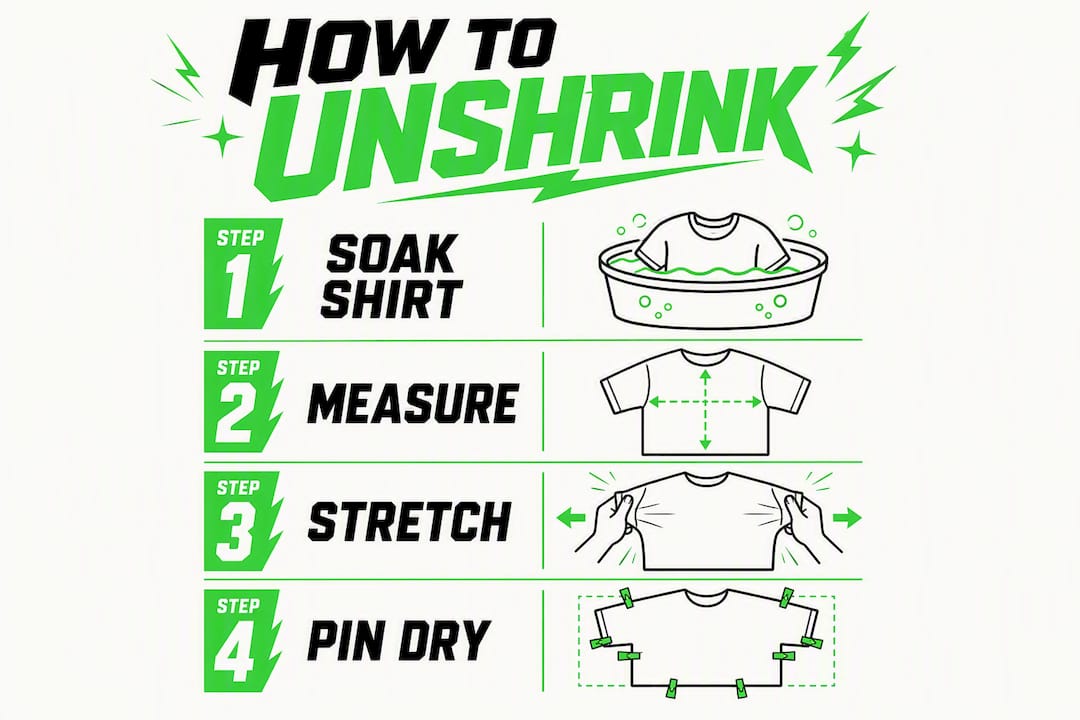
- Fill the basin with lukewarm water. Add the conditioner or baby shampoo at roughly 1 tablespoon per quart and stir gently to combine.
- Submerge the shirt fully. Press it down so every part of the fabric is saturated. No wringing, no scrubbing.
- Soak for 30 minutes. Don’t rush this. The conditioner needs time to penetrate and lubricate the fibers.
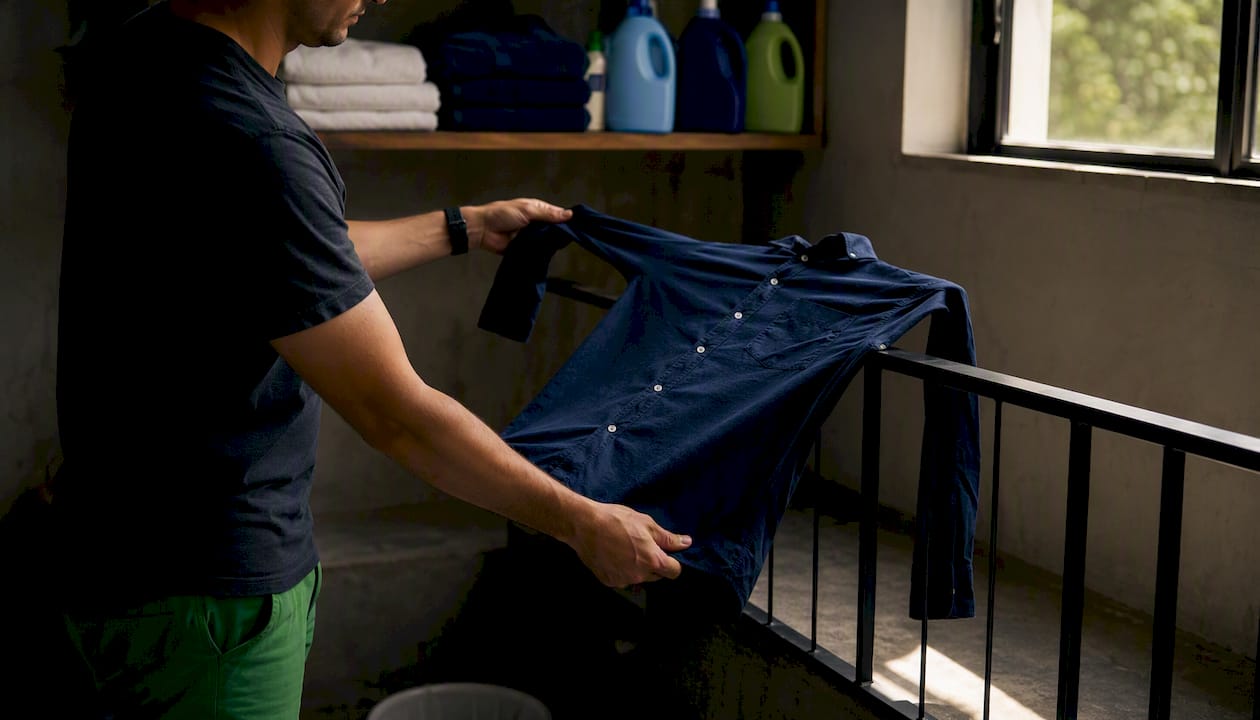
- Do not rinse. Lift the shirt out of the water and let it drip briefly, but leave the conditioner in the fabric. Rinsing removes the lubricant you need for stretching.
- Press out excess water with a towel. Lay the shirt flat on a dry towel, roll the towel up with the shirt inside, and press firmly along the roll. Unroll and transfer the shirt to a second dry towel. Never wring or twist.
- Stretch section by section. Working on the flat surface, use both hands to gently pull the fabric outward. Work the shoulders first, then the body, then the sleeves. Small, steady pulls beat one aggressive tug.
- Pin or weight the shirt to hold its shape. Use rustproof pins at the hem, shoulders, and cuffs, or place small weights at the edges. If you have a similar-fitting shirt, lay it on top as a size template and stretch to match.
- Air-dry completely before removing the pins. This is the step most people skip. Fibers will contract back toward the shrunken shape if you remove the pins while the shirt is still damp. Full drying can take 4–8 hours depending on fabric weight and humidity.
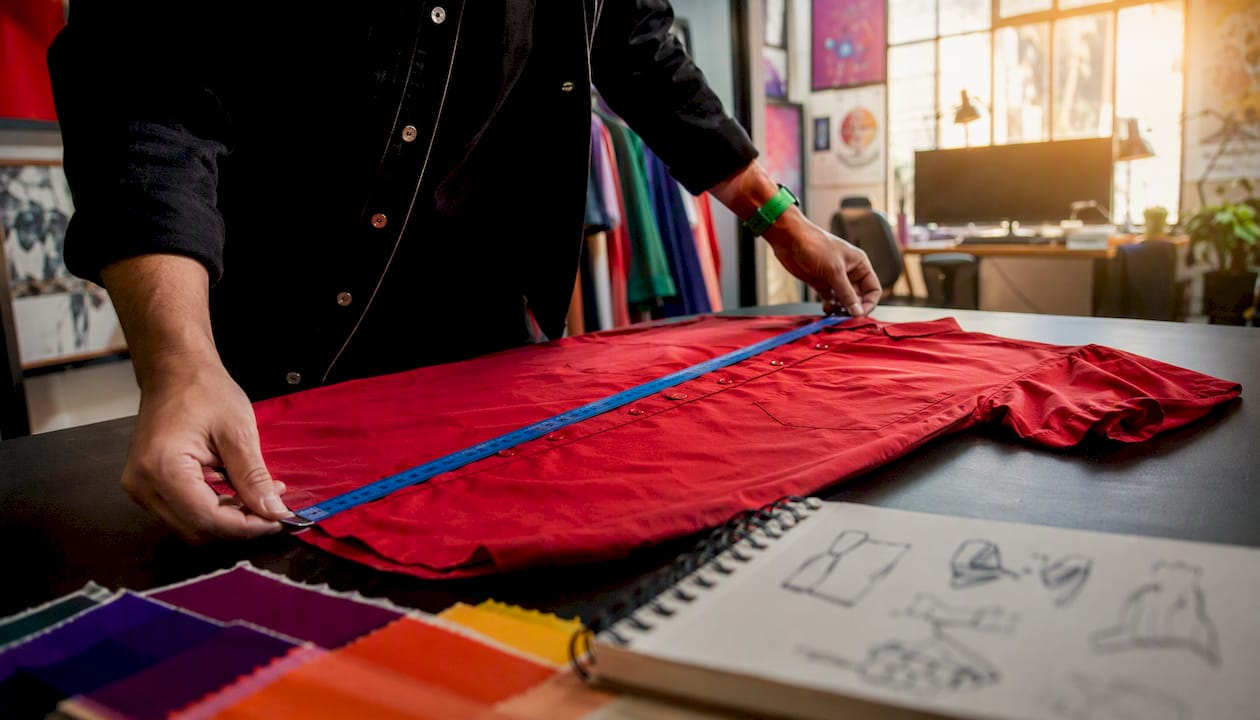
Pro Tip: Measure a shirt that fits you well before you start. Write down the chest width, body length, and sleeve length, then use those numbers as your target while stretching. Guessing by eye usually undershoots.
If the fabric resists in one area
Some areas, particularly the collar and cuffs, are more tightly woven and resist stretching. Work those spots with your fingers in small circular motions while the fabric is still wet. A second short soak (10 minutes) with fresh conditioner solution can help if one area stays stubbornly tight.
Other approaches when the conditioning soak isn’t enough
The conditioning soak covers most cases, but a few situations call for a different approach.
Steam blocking for wool
Steam is gentler than water immersion for delicate wool knits and structured garments. Hold a garment steamer or the steam function of an iron a few inches from the fabric, let the steam penetrate for 30–60 seconds per section, then stretch and pin immediately. Steam blocking works well for sweaters and structured wool pieces where full immersion might distort the shape. The limit: it delivers less lubrication than the conditioning soak, so recovery is usually smaller.
Professional textile restoration or tailoring
If the shirt has significant sentimental or monetary value, a professional textile restorer or dry cleaner with wet-blocking experience can attempt a more controlled recovery. Tailors can also take in seams or add stretch panels if the shirt shrank unevenly. Tailoring makes sense when the shirt cost more than the alteration, which typically runs $15–$40 for basic adjustments at most local shops.
| Approach | Best For | Limits | Rough Cost |
|---|---|---|---|
| Conditioning soak | Cotton, linen, light wool | Won’t fix synthetics or felted wool | Under $1 |
| Steam blocking | Structured wool, knits | Smaller recovery range | Under $5 (home steamer) |
| Professional restoration | High-value or delicate garments | Not always available; results vary | $15–$40 |
| Tailoring | Permanent shrinkage, uneven fit | Alters original design | $15–$40 |
| Replacement | Irreversible damage | Loses the original garment | Varies |
How to keep shirts from shrinking again
Prevention is simpler than recovery, and for printed graphic tees especially, it’s worth building a habit.
Do:
- Wash in cold water on a gentle or delicate cycle. Cold water is the single biggest factor in preventing shrinkage for cotton and blends.
- Air-dry flat or hang to dry away from direct sunlight and heat sources. Laundry experts consistently point to high-heat drying as the primary cause of irreversible shrinkage in printed tees.
- Use a gentle, low-pH detergent. Harsh detergents weaken fibers over time, making them more prone to distortion.
- Turn printed shirts inside out before washing. This protects the graphic from friction and fading.
- Treat stains promptly and wash on gentle, cold cycles to avoid repeated heat exposure from re-washing.
Don’t:
- Use a high-heat dryer setting on untested fabrics, even once. A single hot cycle can set permanent shrinkage.
- Choose high-spin cycles for delicate or printed shirts. Mechanical agitation is the second major cause of shrinkage after heat.
- Wash in hot water for any shirt you haven’t already confirmed is heat-stable.
- Overload the drum. Crowded loads create friction and uneven heat distribution.
For Simpletee’s tri-blend graphic tees specifically: cold wash, inside out, gentle cycle, then hang to air-dry. That routine protects both the fit and the print. Tri-blend fabrics (typically cotton, polyester, and rayon) are softer and lighter than 100% cotton, but the rayon component is particularly sensitive to heat and agitation.
When unshrinking fails: your next options
If one full attempt at the conditioning soak doesn’t restore a wearable fit, a second attempt rarely changes the outcome. At that point, three paths make sense.
Tailoring. A tailor can add side panels, let out seams, or install stretch inserts to recover an inch or two of width. This works best for shirts with enough seam allowance and no print running to the edge. Budget $15–$40 and a week’s turnaround at most local shops.
Repurposing. A shirt that’s too small to wear can become a cleaning cloth, a patch source for other garments, or material for a small sewing project. Not glamorous, but better than landfill.
Replacement. If the shirt shrank beyond recovery and tailoring costs more than the shirt is worth, replacement is the practical call. For a graphic tee priced at $24.99, replacing it is almost always faster and cheaper than a tailor visit.
A simple decision rule: try the DIY method once. If the shirt still isn’t wearable after a single full attempt and complete air-dry, move to one of the three options above rather than repeating the process and risking further distortion.
Why the conditioning soak actually works
Shrinkage happens because heat, water, and agitation cause natural fibers to relax from their stretched manufacturing state and recoil. During manufacturing, fibers are stretched under tension to create fabric. When heat and moisture hit them, that tension releases and the fibers snap back to a shorter, tighter configuration.
Conditioner and baby shampoo contain cationic surfactants. These molecules temporarily coat individual fiber surfaces and reduce the friction between them, making the fibers slippery enough to slide past each other when you apply gentle manual force. That’s the window for stretching.
The critical word is temporarily. Once the shirt dries, the surfactant effect fades and the fibers re-set in whatever position they dried in. That’s why pinning and blocking while the shirt air-dries isn’t optional; it’s the mechanism that makes the recovery stick.
Synthetics fail this method because polyester and nylon don’t shrink through fiber recoil. They shrink through heat-induced structural deformation at the molecular level. No surfactant changes that.
Key Takeaways
A 30-minute conditioning soak followed by pinned air-drying is the most reliable home method to stretch a shrunken shirt back to a wearable fit, and it works best on natural fibers like cotton, wool, and linen.
| Point | Details |
|---|---|
| Best candidate fabrics | Cotton, wool, linen, and light blends respond well; synthetics and felted wool do not. |
| Soak ratio and time | Use 1 tablespoon of conditioner or baby shampoo per quart of lukewarm water; soak for 30 minutes. |
| Critical step: pin while drying | Fibers re-set as they dry, so pin or weight the shirt to its target dimensions and air-dry completely. |
| Key warnings | No heat, no wringing, no rinsing the conditioner out; one attempt is usually the limit. |
| Simpletee tri-blend tees | Wash cold, inside out, on a gentle cycle and air-dry to protect both fit and print from the start. |
The part most guides skip
Most unshrinking articles treat the method as a magic fix and skip the honest part: recovery is partial for most shirts, and the conditioning soak is really a second chance, not a reset button. A shirt that shrank 15% in a hot dryer might come back 10%. That’s a meaningful difference, but it’s not the same shirt it was.
What actually matters more is the drying step, and not just for recovery. For printed graphic tees, the dryer is the enemy of both fit and print quality. The heat that shrinks the fabric also degrades the ink over time, cracking prints that should last years. Air-drying isn’t just a shrinkage fix; it’s the single habit that extends the life of a graphic tee more than any other.
If you’re the kind of person who cares enough about a shirt to spend 45 minutes trying to restore it, you’re also the kind of person who should never put that shirt in a hot dryer again. The method works. The prevention works better.
When your shirt can’t be saved, Simpletee has a replacement worth keeping

If the conditioning soak didn’t bring your shirt back, there’s a straightforward next step. Simpletee’s tri-blend graphic tees are built for exactly the kind of fan who treats their shirts as more than just clothing. Every design, from Lord of the Rings and Star Wars to TMNT and beyond, is printed on a soft tri-blend fabric that holds its shape and color when you treat it right. At $24.99, replacing a lost shirt costs less than a tailor visit and gets you something you’ll actually want to wear.
The Rebel Forever tee and the Stone and Dagger design are two strong picks if you want something that wears in rather than wears out. Browse the full collection at Simpletee’s graphic tee store and find the design that fits your fandom.