

Fabric weight is simply mass per unit of area, measured in grams per square meter (GSM) or ounces per square yard (oz/yd²). This is t-shirt weight explained in the way that actually helps you shop or design: lightweight runs about 120 to 150 GSM (roughly 3.5 to 4.5 oz), midweight sits at 150 to 180 GSM (about 4.5 to 5.5 oz), and heavyweight starts around 180 to 240+ GSM (6 oz and above).
- Lightweight: 120–150 GSM / 3.5–4.5 oz
- Midweight: 150–180 GSM / 4.5–5.5 oz
- Heavyweight: 180–240+ GSM / 6+ oz.
Why any of this matters: weight drives how a shirt drapes, how warm it feels, how long it survives the wash, and how well it takes a print. Get the band wrong for your use case and you’ll notice it the first time you wear the shirt or run a print job.
Key Takeaways
Midweight fabric between 150 and 200 GSM offers the most reliable balance of comfort, durability, and print compatibility across DTG, screen printing, and embroidery.
| Point | Details |
|---|---|
| Know your bands | Lightweight runs 120–150 GSM, midweight 150–180 GSM, heavyweight 180–240+ GSM. |
| Convert carefully | 1 oz/yd² equals about 33.91 GSM, so always check which unit a supplier quotes. |
| GSM isn’t the full story | Fiber, yarn, knit structure, and finishing change how identical GSM fabrics feel. |
| Match weight to print method | DTG favors 119–180 GSM; screen printing and embroidery favor 170–220+ GSM. |
| Simpletee uses midweight tri-blend | Its $24.99 graphic tees use tri-blend blanks in the midweight range built for clean prints and daily wear. |
Table of Contents
- How Is T-Shirt Fabric Weight Measured?
- What Are the Typical T-Shirt Weight Ranges?
- Why Do Shirts With the Same GSM Feel Different?
- How Does Weight Affect Comfort, Durability, and Printing?
- How Much Does Garment Weight Affect Shipping Costs?
- How Do You Choose the Right T-Shirt Weight?
- How Simple Tee Applies Weight Guidance to Real Products
- Frequently Asked Questions
- Sources
How Is T-Shirt Fabric Weight Measured?
GSM is the number you’ll see most often on spec sheets, and it works exactly like it sounds: cut a sample of fabric, weigh it in grams, divide by its area in square meters. Mills reference ISO 3801 as the standard test method for woven fabrics, which gives suppliers a consistent way to report the number across factories and countries.
Oz/yd² is the American version of the same idea, and the two convert cleanly: 1 oz/yd² equals about 33.91 GSM. So a 5 oz shirt lands close to 170 GSM, and a 180 GSM shirt is roughly 5.3 oz. If a supplier only gives you one unit, do the math before you compare it to a competitor’s spec.
You’ll also see the term “singles” on yarn-heavy spec sheets. This refers to yarn count. Higher singles (like 30s or 40s) mean thinner, finer yarn, which produces a lighter, smoother fabric at the same GSM. Lower singles (18s or 20s) feel coarser and chunkier. Two shirts can share a GSM number and still feel completely different because of this.
Checklist for reading a spec sheet:
- Confirm the nominal GSM, not just a range.
- Ask for the allowed tolerance (often plus or minus 5%).
- Check whether the GSM was measured pre-wash or post-wash. Cotton shrinks and can gain apparent weight after laundering.
Pro Tip: Always ask “GSM measured how, and when?” A pre-wash spec on a heavy-shrink cotton can read lighter than what actually ships to you.
What Are the Typical T-Shirt Weight Ranges?
Numbers help more than adjectives here, so here’s a banded breakdown with real garment weights attached.
- Very light (under 140 GSM, about 4.1 oz): airy, almost sheer at times, common in performance and summer tees.
- Lightweight (140–160 GSM, 4.1–4.7 oz): a medium finished shirt in this band often lands around 130 to 150 grams.
- Midweight (160–200 GSM, 4.7–5.9 oz): the industry’s common starting zone for everyday retail tees, with a medium shirt typically weighing 150 to 180 grams.
- Heavyweight (200–240+ GSM, 5.9–7.1+ oz): a medium tee here can weigh 180 to 220 grams or more, common in streetwear and workwear.
A medium cotton t-shirt generally finishes between 4.5 and 5.5 oz (128 to 156 grams), which lines up with the midweight band most brands default to.
Here’s a shipping rule of thumb: depending on the weight band, roughly 3 to 4 medium tees add up to about 1 pound. A lightweight 140 GSM shirt at around 135 grams means nearly 3.4 shirts per pound, while a heavyweight 220 GSM shirt at 200 grams pushes closer to 2.3 shirts per pound. If you’re packing a multi-shirt order, that difference changes your box count fast.
Why Do Shirts With the Same GSM Feel Different?
Two fabrics can list an identical GSM and still feel like different products in your hands, and this trips up a lot of first-time buyers.
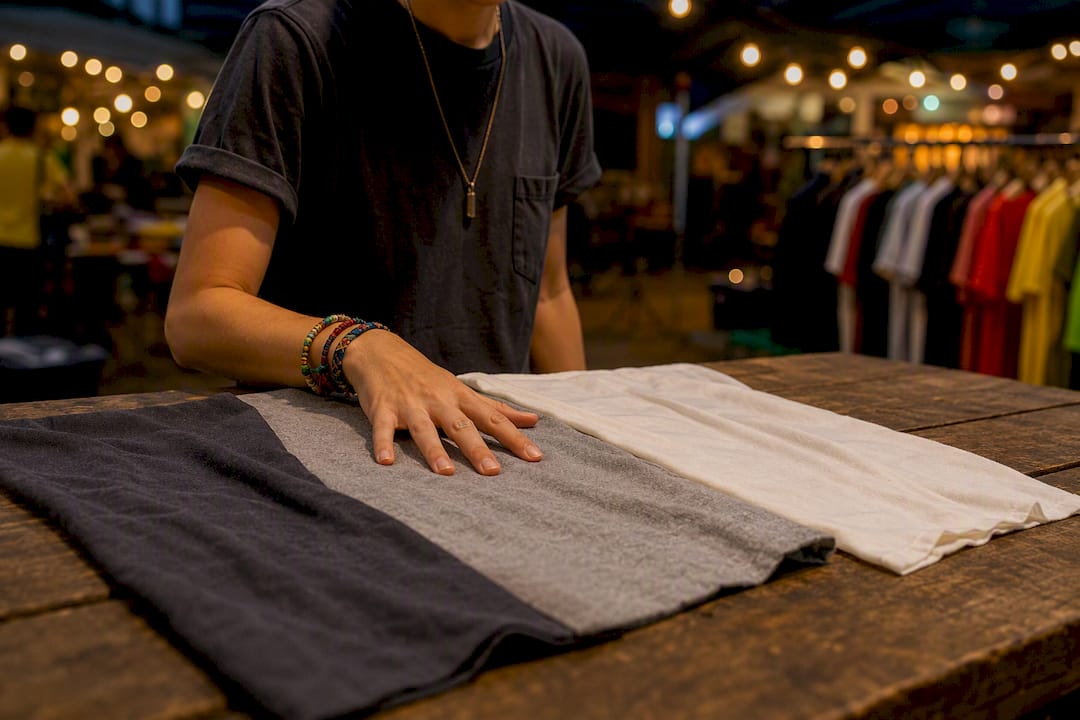
Fiber type is the biggest factor. Cotton absorbs moisture and breathes but holds weight when damp. Polyester dries faster and often feels lighter even at a comparable GSM because of how the fiber packs. Tri-blends split the difference, combining cotton’s softness with polyester’s structure and rayon’s drape.
Yarn and knit structure matter just as much. Combed and ringspun cotton produces a smoother, tighter yarn than open-end cotton, which changes hand feel without necessarily changing GSM. Knit structure counts too: jersey knit (the standard tee fabric) behaves differently than interlock, which is denser and more stable.
Finishing and construction add or subtract perceived weight. Enzyme washes soften fabric and can reduce apparent bulk. Heavier stitching, doubled hems, and side seams all add a few extra grams that never show up on a raw fabric spec sheet.
- Fiber blend changes drape and moisture behavior independent of GSM.
- Combed/ringspun yarn feels finer than open-end at the same weight.
- Enzyme washing and trim choices shift hand feel and finished weight.
- Knit structure (jersey vs. interlock) changes stretch and drape.
Pro Tip: GSM tells you the starting point, not the whole story. Order a swatch before committing to a bulk run, especially when switching suppliers.
How Does Weight Affect Comfort, Durability, and Printing?
Weight decides more than how a shirt looks on a hanger. It shapes how it wears through a summer afternoon and how well it survives a screen print.
Lighter fabrics breathe better and drape closer to the body, which is why race shirts and festival merch lean toward the 120 to 150 GSM range. Heavier fabrics add structure and warmth, which is exactly why hoodies, workwear, and cold-weather tees climb past 200 GSM. Durability generally improves with weight, but only when the yarn and construction hold up their end. A dense, well-spun 180 GSM shirt can easily outlast a poorly built 220 GSM one.
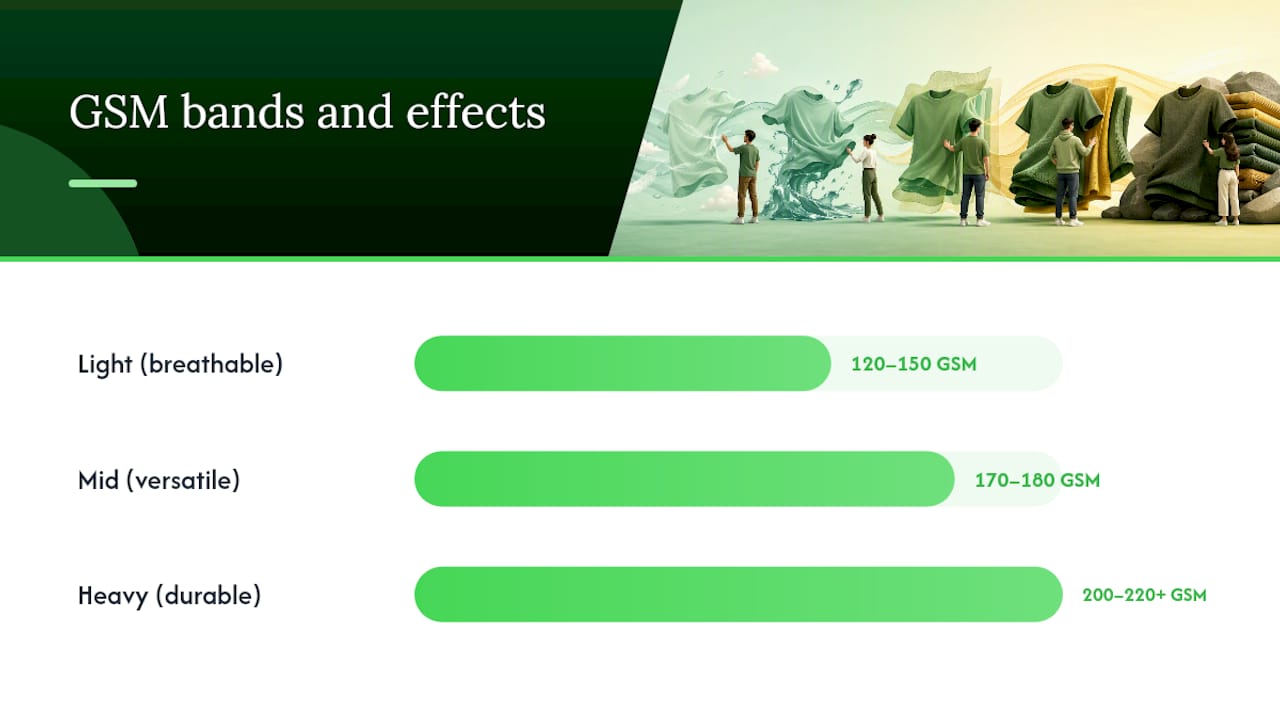
Printing is where weight choice gets specific. DTG printing works best on lightweight to midweight fabrics, roughly 119 to 180 GSM, because tight, high-cotton knits absorb ink cleanly without excess texture interfering with detail. Screen printing and embroidery favor midweight to heavyweight fabrics, around 170 to 220+ GSM, since denser material holds ink layers and stitch tension without puckering.
| Printing method | Best weight range | Why |
|---|---|---|
| DTG (direct-to-garment) | ~119–180 GSM | Tight, high-cotton knit absorbs ink cleanly |
| Screen printing | ~170–220+ GSM | Denser fabric supports ink layers, resists show-through |
| Embroidery | ~180–220+ GSM | Heavier weave anchors stitches without puckering |
A few production notes worth knowing before you run a full batch:
- Heavier fabrics can reduce curing time and reject rates in screen printing because they hold heat and ink more evenly.
- Lighter fabrics are more prone to puckering under heavy ink coverage or dense embroidery.
- Always run a sample print and a wash test before committing to bulk production, especially with a new blank or a design with heavy coverage.
How Much Does Garment Weight Affect Shipping Costs?
Finished-garment weight determines your shipping tier, and small differences add up fast across an order of multiple shirts. A midweight small typically finishes around 130 to 150 grams, a medium around 150 to 180 grams, a large near 180 to 210 grams, and an XL closer to 200 to 230 grams.
Carriers price in weight bands, often starting at the 1 pound mark, so merchants commonly estimate 150 to 180 grams per medium tee when budgeting shipping, then add another 1 to 2 ounces for packaging like polybags or mailers.
- Two midweight mediums (about 300 to 360 grams total) often clear 1 pound once packaging is added.
- Three lightweight mediums may still sit under that same 1 pound threshold.
- Bundling orders to land just under a carrier’s next weight tier is one of the simplest ways to shave shipping cost on multi-item orders.
How Do You Choose the Right T-Shirt Weight?
Start with the use case, not the GSM number. Summer or performance pieces point toward lightweight blanks. Everyday retail tees do well in the midweight zone. Premium or streetwear drops often want the heft of heavyweight fabric.
- Match the weight band to your product brief: light for summer and performance, midweight for everyday wear, heavyweight for premium or structured pieces.
- Request a swatch or sample and put the target GSM, tolerance, and test condition (pre or post wash) directly on your tech pack.
- Pick blanks suited to your printing method, whether that’s DTG, screen printing, or embroidery, and run a sample print plus a wash test before ordering in bulk.
- Factor in shipping weight and retail price positioning, since heavier fabric costs more to ship and typically supports a higher price point.
Pro Tip: If you’re torn between two weights, order both as samples and wear each for a full day before deciding. Spec sheets don’t tell you how a shirt feels at hour six.
How Simple Tee Applies Weight Guidance to Real Products
Simpletee builds its graphic tees on tri-blend fabric, which lands comfortably in the midweight zone this guide recommends for printed designs. Products like Natural Sprinter, Stone and Dagger, and Rebel all use this blank, chosen because tri-blend balances softness, drape, and enough density to hold detailed prints without puckering.
- Tri-blend construction combines cotton, polyester, and rayon for a soft hand with real print stability.
- Every design lands at $24.99, keeping premium blanks accessible for everyday fans.
- Ordering a sample and checking the spec sheet before a bulk purchase is good practice regardless of where you buy.
A practical note on picking weight for graphic tees
Midweight tri-blend blanks solve more problems than they cause. They print cleanly across most methods, hold their shape after repeated washing, and still feel light enough for daily wear, which is why they show up so often across Simpletee’s lineup rather than defaulting to either extreme. Routine swatch checks, a wash test, and a real print trial catch the surprises that spec sheets alone never will.
Try a Tri-Blend Blank Built Around Midweight Comfort
If you’ve been comparing GSM charts trying to figure out what actually shows up at your door, the simplest test is to hold a shirt in your hands. Simpletee’s tri-blend tees sit in the midweight range this guide points to for printed graphics, giving you a fabric that drapes well, survives regular washing, and takes detailed artwork without puckering.

Browse the full lineup on the Simpletee store, or start with a single order of Rebel Forever to feel the weight and print quality firsthand. Every design runs $24.99 across the standard adult size range, so checking fit and fabric feel on one shirt before ordering more costs you almost nothing.
Frequently Asked Questions
What is a good t-shirt weight for everyday wear? Most everyday retail tees land in the midweight range, about 160 to 200 GSM. This band holds its shape through repeated washing while still feeling comfortable for all-day wear.
How do I measure t-shirt weight without a lab scale? You generally can’t get lab-accurate GSM at home, but you can weigh a finished shirt on a kitchen scale and compare it against known ranges. A medium shirt weighing 150 to 180 grams is almost certainly midweight.
Is heavier always better for durability? Not necessarily. A well-constructed midweight shirt with quality yarn can outlast a poorly made heavyweight one. Weight helps, but yarn quality and stitching matter just as much.
What weight works best for DTG printing? DTG performs best on lightweight to midweight cotton, roughly 119 to 180 GSM, since tighter knits absorb detailed ink patterns more cleanly than looser, heavier weaves.
How many t-shirts fit in a 1-pound shipment? It depends on the weight band, but roughly 3 to 4 medium tees equal about 1 pound. Lightweight shirts push closer to 4 per pound, while heavyweight shirts land nearer 2 to 3.
Sources
- T-Shirt Fabric Weight Guide - Complete GSM Chart 2026
- How much does a shirt weigh? T-shirt weight guide | Printful
- How Much Does a Shirt Weigh? Guide for Small Businesses - Shopify