

The Tengwar alphabet is a featural script created by J. R. R. Tolkien whose letter shapes correspond directly to features of speech — place and manner of articulation — rather than being arbitrary symbols. The single most important thing to understand before you start: Tengwar is not a language. It is a writing system, and the rules for using it change depending on which mode you choose. Modes govern how vowels are handled, and picking the wrong one is the most common beginner mistake. You can absolutely write English in Tengwar — you just need to pick either a Common or Phonemic English mode before you write a single letter.
Key Takeaways
The Tengwar alphabet is a featural script where letter shapes encode articulation, and mode selection — not letter memorization — is the skill that unlocks accurate transcription.
| Point | Details |
|---|---|
| Tengwar is featural | Each glyph’s telco and lúva encode place and manner of articulation, not arbitrary symbols. |
| Modes control vowels | Quenya uses tehtar on the preceding consonant; Beleriand uses full vowel letters; English modes vary by spelling or pronunciation. |
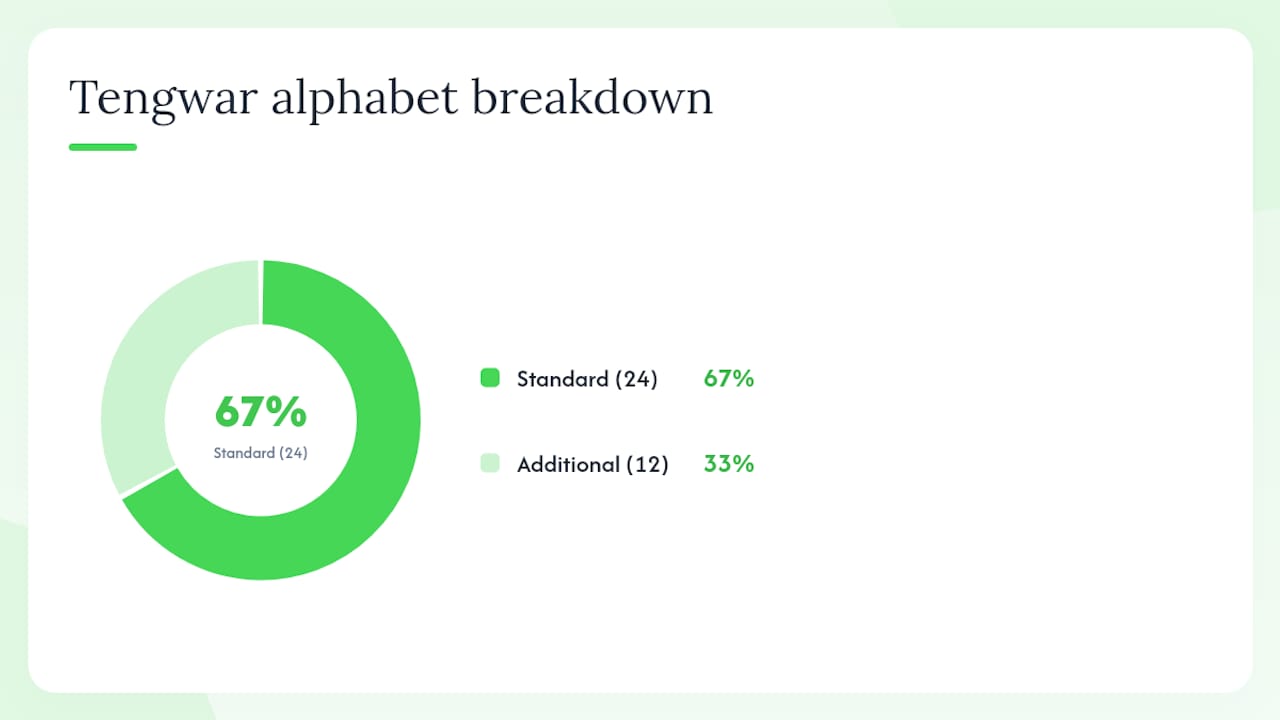
| 36-letter inventory | The standard display shows 24 core tengwar plus 12 additional letters arranged in a grid of series and rows. |
| Tehtar placement is critical | The most common beginner error is placing a vowel tehta above the wrong consonant; always check against a reference chart. |
| Use authoritative tools | Tecendil, Tolkien Gateway, and Amanye Tenceli are the most reliable free references; verify any converter documents its mode. |
Table of Contents
- How is the Tengwar alphabet actually built?
- Which mode should you use?
- How to transcribe your first word, step by step
- Worked examples: the One Ring and beyond
- Where to find reliable references and tools
- Modes are conventions, not commandments
- Why Tengwar is worth the learning curve
- Wear the script: Tengwar-inspired Middle-earth apparel
- Sources
How is the Tengwar alphabet actually built?
Every Tengwar glyph is assembled from two physical parts: a telco (stem) and a lúva (bow). Amanye Tenceli’s documentation explains how stem position and bow modifications signal phonetic relationships — raising the stem can indicate spirantization, and doubling the bow can indicate voicing in certain modes. That is what “featural” means in practice: the shape of the letter tells you something about how the sound is made.
The full inventory, as Tolkien Gateway notes, displays 36 letters: 24 standard tengwar arranged in a grid plus 12 additional tengwar for sounds outside the core system. The 24 standard letters sit in a table organized by témar (series, columns) and tyeller (rows). Columns map to place of articulation — dental, labial, velar, and palatal — while rows map to manner: voiceless stops, voiced stops, voiceless fricatives, and so on. Once you internalize that grid, you can predict what a tengwa sounds like from its shape alone.
Vowels work differently, and this is where beginners stumble.
- Tehtar are small diacritical marks written above or below a consonant tengwa. They represent vowels and do not stand alone.
- Carriers are placeholder glyphs used when a vowel has no adjacent consonant to attach to. A short carrier handles a single vowel; a long carrier handles a long vowel.
- Full-letter vowels appear in certain modes (notably the Beleriand mode for Sindarin) where vowels get their own dedicated tengwar rather than being written as tehtar.
- The reading convention for tehtar placement varies by mode: in Quenya mode, a tehta sits above the consonant that precedes the vowel; in some English modes, it sits above the consonant that follows.
A quick example: the word calma (Quenya for “lamp”) would be written with the tengwa for c, the tehta for a placed above it, the tengwa for l, the tehta for a again, the tengwa for m, and the tehta for a once more — reading left to right, each vowel mark rides on the consonant to its left.
Which mode should you use?
A mode is an orthographic convention: a set of rules that maps a specific language’s sounds (or spelling) onto the Tengwar system. Tecendil’s Tengwar Handbook documents the main modes and distinguishes full-writing modes from ómatehtar (vowel-tehta) modes. Modes evolved over time and are not immutable laws — they are conventions that Tolkien himself revised and adapted.
The three main mode families you will encounter:
Quenya mode uses ómatehtar: vowels are written as tehtar placed on the preceding consonant. There are no standalone vowel letters except when a vowel begins a word (a carrier handles that). This is the mode Tolkien used most consistently in his manuscripts and the one most learning resources start with.
Sindarin modes split into two branches. The Beleriand mode is a full-writing mode: vowels get their own tengwar, no tehtar needed. It appears in the Book of Mazarbul inscription in The Lord of the Rings. The Gondor mode is an ómatehtar mode adapted for Sindarin phonology, closer in structure to Quenya mode but with different letter assignments.
English modes come in several flavors. The Common English mode follows English spelling rather than pronunciation — so “knight” maps to its letters, not its sounds. The Phonemic English mode maps to pronunciation, so “knight” becomes something closer to /naɪt/. The Traditional English mode sits between the two. For decorative use on apparel or LOTR elvish phrases on a shirt, the Common mode is usually the clearest choice because readers can decode it without knowing phonetic notation.
| Mode | Vowel method | Best for | One-line example |
|---|---|---|---|
| Quenya | Tehtar on preceding consonant | Quenya names and phrases | Elen síla — tehtar above each consonant |
| Sindarin Beleriand | Full vowel letters | Sindarin inscriptions, Book of Mazarbul style | Ennyn Durin — vowels as full tengwar |
| Sindarin Gondor | Tehtar on preceding consonant | Sindarin in ómatehtar style | Similar to Quenya layout, different letter map |
| English Common | Tehtar following spelling | English names, shirt designs | “Tolkien” spelled letter-by-letter |
| English Phonemic | Tehtar following pronunciation | Accurate English transcription | “Tolkien” mapped to /tɒlkiːn/ sounds |
How to transcribe your first word, step by step
The process is shorter than it looks. Follow these steps for any short word or name:
- Choose your mode. Decide before you write anything. Quenya mode for Quenya text, Beleriand for Sindarin inscriptions, Common English for English names on apparel.
- Break the word into phonemes (or letters). For Quenya and Sindarin, work from pronunciation. For Common English mode, work from spelling.
- Map each consonant to its tengwa. Use a reference chart — Tecendil’s handbook or the Tolkien Gateway table. Find the correct series (column) and row for each consonant.
- Place the vowel tehtar. In Quenya and Gondor modes, each vowel tehta goes above the consonant before it. If the word starts with a vowel, use a short carrier as the base.
- Apply doubling and nasal markers. A doubled consonant is written with a horizontal bar beneath the tengwa rather than repeating the glyph. The nasal marker (a bar above) handles m and n before another consonant in many modes.
- Add punctuation and spacing. Tengwar uses dots rather than Western punctuation: a single dot functions like a comma, two dots like a semicolon or period. A wavy line marks a larger break or end of text. There is no capitalization in Tengwar.
Common pitfalls to watch for:
- Tehtar on the wrong consonant. In Quenya mode, the tehta goes on the consonant before the vowel, not after. Reversing this is the single most frequent error.
- Mapping English spelling instead of pronunciation (or vice versa). Decide which mode you are using and stay consistent. “Phone” in Phonemic mode starts with an f sound, not a p.
- Assuming capitalization exists. It does not. Proper nouns get no special treatment in Tengwar.
- Ignoring silent letters. In Common English mode, silent letters are usually still written. In Phonemic mode, they are not.
Here is a small reference for the most common tehtar vowel marks:
Punctuation follows a similar logic: Amanye Tenceli’s documentation confirms that dot arrangements signal pauses, with conventions varying across manuscripts and modes.
Worked examples: the One Ring and beyond
The One Ring inscription is the most famous Tengwar text in existence, and it is a good teaching example because Tolkien wrote it himself. The inscription uses a Black Speech mode — not Quenya, not Sindarin. It is written in a continuous line without word breaks, right to left, and uses full-letter vowels rather than tehtar. The tengwar shapes are the same standard inventory, but the mode rules differ from anything you would use for Elvish.
The full inscription reads: Ash nazg durbatulûk, ash nazg gimbatul, ash nazg thrakatulûk agh burzum-ishi krimpatul. The noteworthy orthographic choices: long vowels are marked with a raised dot on the carrier, and the nasal cluster in “nazg” uses the nasal bar convention.
Short Quenya phrase example: Elen síla lúmenn’ omentielvo (“A star shines on the hour of our meeting”). In Quenya mode, every vowel is a tehta on the preceding consonant. The long vowels (marked with an accent in Roman script) use a long carrier or a doubled tehta, depending on the manuscript tradition. The apostrophe in lúmenn’ signals elision and is typically omitted in Tengwar.
English Common vs. Phonemic side by side: Take the name “Frodo.”
- Common mode: F-R-O-D-O, mapped letter by letter. The tehta for o sits above the r and above the d respectively.
- Phonemic mode: /froʊdoʊ/, same result here because “Frodo” is spelled phonetically — but try “Gandalf” and the two modes diverge slightly on the final consonant cluster.
Practice exercise: Write your own name in Common English mode. Check three things: (1) Is each vowel tehta sitting above the consonant to its left? (2) Did you use a short carrier for any vowel that starts the name or follows another vowel? (3) Did you accidentally capitalize the first letter? If you caught all three, you are ready to move to a two-syllable Quenya word.
Where to find reliable references and tools
The quality of Tengwar resources varies enormously. Some online converters use idiosyncratic mode rules with no documentation; others are meticulous. Here is where to start:
Primary references:
- Tecendil’s Tengwar Handbook is the most thorough freely available mode reference. It documents Quenya, Beleriand, and Gondor modes with worked examples and is updated when scholarly consensus shifts.
- Tolkien Gateway’s Tengwar page gives a solid overview of the letter inventory, Quenya names for each tengwa, and historical development notes.
- Wikipedia’s Tengwar article is a reliable entry point with a good mode comparison table and links to primary Tolkien sources.
- Amanye Tenceli goes deeper on the telco/lúva mechanics and provides diagrams that no other free resource matches.
- The Elvish documents phrases from the Peter Jackson films, useful for checking film-mode samples against scholarly Tengwar.
Fonts and converters:
- The Tengwar Annatar and Tengwar Formal font families by Johan Winge are the most widely used Unicode-adjacent fonts for Tengwar. They map glyphs to the proposed Unicode block described in Evertype’s encoding notes.
- Tecendil’s online converter is mode-configurable and shows carriers explicitly — the two features that matter most.
Evaluation checklist for any tool you consider:
- Does it document which mode it uses?
- Can you switch between Quenya, Sindarin, and English modes?
- Does it render carriers and tehtar as separate, visible elements?
- Does it follow the proposed Unicode block structure rather than a private encoding?
- Is there a source or handbook citation for its mode rules?
If a tool fails the first point — no documented mode — treat its output as decorative rather than accurate.
Modes are conventions, not commandments
Tolkien experts consistently note that modes evolved across Tolkien’s manuscripts and were never finalized into a single canonical system. The Wikipedia Tengwar article makes this explicit: Tolkien adapted the script for multiple languages and revised conventions over decades. That is not a weakness of the system; it is a feature. It means you have legitimate flexibility when adapting Tengwar for practical use.
When is adaptation acceptable? Three situations come up most often:
- Legibility constraints. On a small print or embroidered design, tehtar can become illegible. Switching to a full-writing mode for that context is a reasonable trade-off.
- Typographic limitations. Some font rendering environments do not handle non-spacing marks reliably. Using a mode that places vowels as full letters sidesteps the problem.
- Design use on apparel. Elvish phrases for shirts often prioritize visual balance over strict phonological accuracy. A symmetrical arrangement of tengwar may require minor spacing adjustments that a purist would flag.
The key constraint: stay internally consistent within a single piece. Mixing Quenya mode rules with Gondor mode rules in the same inscription produces something that looks right but reads as nonsense to anyone who knows the system.
Pro Tip: Before starting any Tengwar project, write down the mode name and three specific orthographic choices you are making (tehtar placement, long vowel convention, nasal bar usage). Keep that note next to your work. Consistency across a design matters more than perfection on any single letter.
Why Tengwar is worth the learning curve
The aesthetic appeal of Tengwar is obvious the moment you see it. The curves and stems have a calligraphic elegance that no Latin-derived script quite matches, and the featural logic means that once you understand the grid, the script feels almost inevitable rather than arbitrary. That combination of beauty and internal logic is what keeps people coming back to it.
The frustrations are equally predictable. Most beginners hit the same wall: they learn the letter shapes from a chart, then immediately try to write a full sentence and get the tehtar placement wrong on half the vowels. The mode rules feel abstract until you have worked through five or six words by hand.
The most frequent beginner mistakes, worth naming plainly:
- Mixing mode rules mid-word. Quenya tehtar placement on a Gondor-mode word produces errors that are hard to spot without a reference.
- Ignoring pronunciation entirely. For Phonemic English mode, you must work from how the word sounds, not how it is spelled. “Through” has one vowel sound, not five letters.
- Treating tehtar as optional decoration. They are not. Omitting them makes the text unreadable to anyone trying to decode it.
The fix is small and doable: write five names, check each one against Tecendil’s handbook, and note every correction. Five names, done carefully, teach more than fifty done from memory. The Tolkien Gateway Tengwar page has a letter table you can print and keep beside you while you practice.
Wear the script: Tengwar-inspired Middle-earth apparel
If you have spent time learning Tengwar, you already know how striking the script looks on a physical object. Simpletee’s Middle-earth graphic tees are built for fans who want that connection to Tolkien’s world on something they can actually wear. The Fellowship Black Metal Edition tee and the For Frodo Black Metal Edition both carry that dark, high-contrast aesthetic that pairs naturally with Elvish script design sensibilities. Every shirt is $24.99, printed on tri-blend fabric, and available in multiple sizes.
Sources
Primary and authoritative references:
Encoding and font resources:
Film and supplementary samples: